



BLOG

A Singularity at the Heart of the Parent-Child Relationship

Parental Guidance by a Psychomotor Therapist

In the journey of parenthood, there are moments of doubt, fatigue, and discouragement. Being a parent means learning to reinvent oneself every day in response to a child who is constantly developing, changing, and questioning. In the face of this ever-shifting reality, parental guidance offered by a psychomotor therapist provides a unique, sensitive, and deeply human approach.

Body-Based Guidance

What sets psychomotor-based parental guidance apart from other forms of support is its bodily point of departure. The psychomotor therapist doesn’t focus solely on observed behaviors or attitudes, but on what unfolds within the body—through movement, through sensory and postural exchanges between parent and child.

A child doesn’t express themselves only through words. They communicate through gestures, silences, posture, and physical reactions to everyday situations.

The parent also speaks with their body: in the way they offer a reassuring touch, hold back anger, tense up, or draw closer.

The psychomotor therapist helps to bring meaning to these invisible interactions—often intuitive, sometimes disorienting.

A Holistic Approach to Parenting

Psychomotor parental guidance does not offer a universal recipe. It does not aim to “correct” the parent or “normalize” the child. It is based on a unique encounter and a careful observation of the relationship, in all its vitality, fragility, and richness.

The psychomotor therapist supports the parent to:

  • See their child differently: through their rhythms, movements, and ways of relating.

  • Welcome their own reactions: bodily tension, fatigue, the need for control or distance.

  • Adjust their gestures, speech, and posture to reinvent a more fluid and secure bond.

A Safe Space to Be Heard, Not Judged

In a society overwhelmed with educational injunctions (“be loving but firm,” “set boundaries but allow freedom”), psychomotor guidance offers a pause—a neutral space where parents can lay down what they are experiencing. It is not about parental performance, but about understanding. It is not about perfection, but about adjustment.

Being a parent isn’t about “doing it right,” it’s about being present, even within one’s limits.

The psychomotor therapist acts as a compassionate mirror, illuminating what is happening in the relationship without imposing a model.

A Renewed Parent-Child Bond

When a parent feels supported and acknowledged in their experience, they regain a sense of agency—not a power over the child, but a power with them. This is the true strength of psychomotor guidance: it restores the bond and rebuilds trust in intuition, in the ability to understand and accompany one’s child with sensitivity.

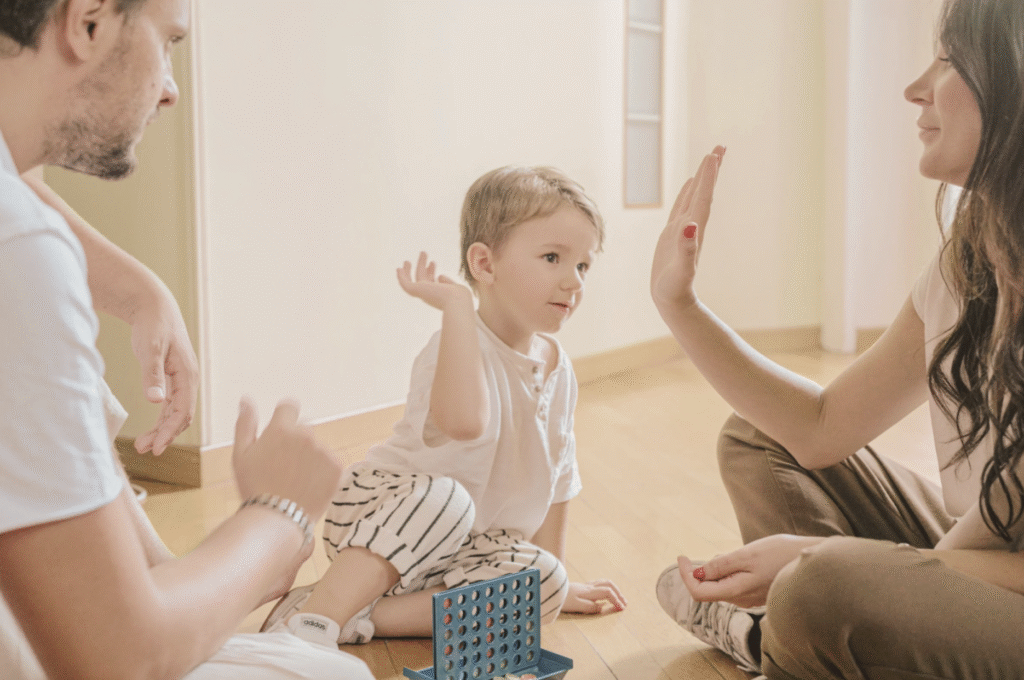
In some sessions, both parent and child are present together: observing, playing, moving. In others, the parent is alone, supported in decoding, feeling, and integrating. In all cases, it is a meeting—a co-construction.

What Makes Psychomotor Parental Guidance So Unique

Aspect

Distinctive features

Body-Centered

Analyzes the bodily and sensory interactions between parent and child.

Holistic Approach

Integrates development, emotions, motor skills, and relationships

Non-normative

Values parental experience and intuition rather than ready-made rules.

Humanistic

Supports without judging, accompanies without imposing.

Creative and flexible

Offers practical, playful, and tailored tools for each family.

 Supporting a child also means supporting those who support them.

Psychomotor parental guidance is a form of active and embodied listening that places the relationship at its center, inviting each parent to make their body and presence a place of safety, attachment, and growth for the child.

BLOG

Read more about psychomotricity

AGB Code: 90094601
Numéro ADELI: 78 96 0267 9

CONTACT

Hygiëastraat 8
1076 RM Amsterdam

0031 0639214629